

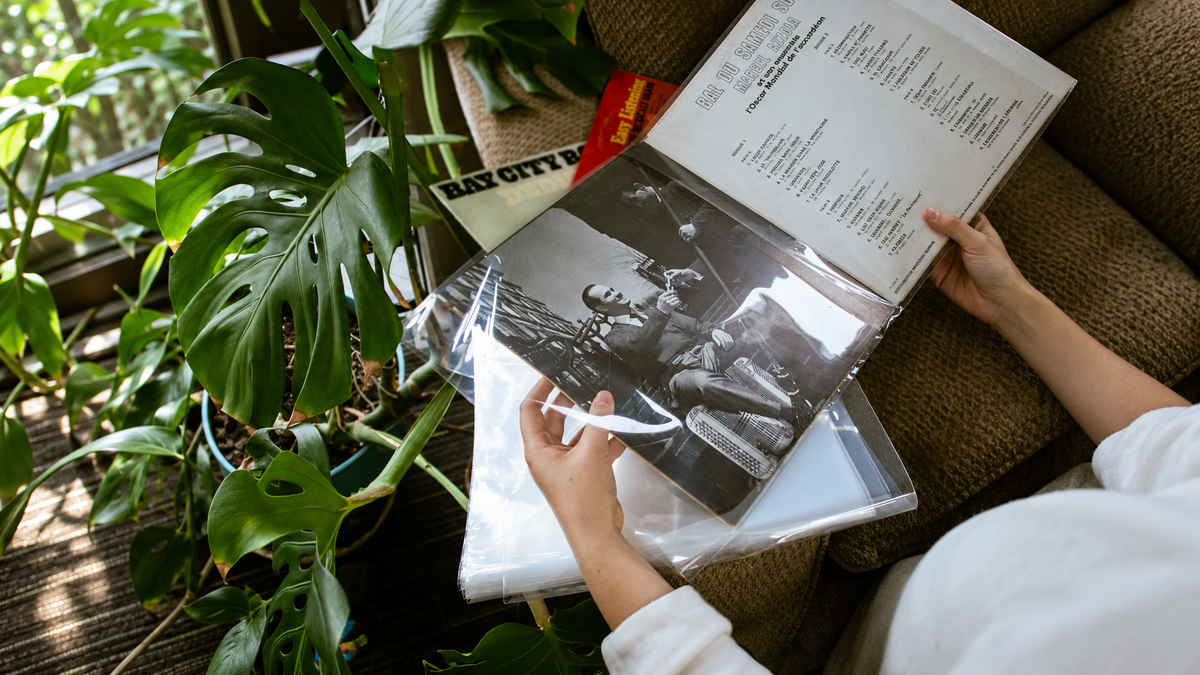
Outer sleeves all look much the same in the packet, but the plastic they're made from makes a real difference. The right one keeps your covers looking new for decades. The wrong one can slowly ruin them and the record within (you can read more about hazing here)
This guide compares the four plastics (3 of which we sell) that you can use to outer sleeve your records, explains what the mil is (spoiler - thickness measure, not milimeter) and helps you pick the right one.
TLDR: BOPET for your most valuable records, BOPP for everyday display, cast PP for thick double LPs and economical covering, BUT never plasticised PVC.
What's the difference between PVC, PP, BOPP and BOPET?
Three of these four plastics are safe for long-term storage. Plasticised PVC isn't, and that's not just collector folklore: the Library of Congress recommends uncoated polyethylene, polypropylene and polyester sleeves and says to avoid PVC.

What is PVC (Polyvinyl Chloride)?
- What it is: A naturally hard plastic that's made soft by mixing in oily chemicals called plasticisers.
- How it feels and smells: Thick, heavy and rubbery, with that "new shower curtain" smell. Check the listing wording too: sellers often call PVC plain "vinyl", so a sleeve described as made of vinyl is PVC. It can also have a really pungent smell - thats the offgassing! Danger!
- Why to avoid it: Its plasticisers slowly seep out, which can leave a milky haze on records and a sticky residue on jackets. We dig into the chemistry in PVC Sleeves, Vinyl Records and our Journey into Chemistry.

What is PP (Polypropylene)?
- What it is: A plastic that's naturally flexible as a thin film, so it needs no softeners.
- How it feels: Smooth, slightly soft and a little stretchy. It's nice and clear, though scuffs can make it look a bit hazy.
-
At Archive Boxes Australia: 12" Vinyl Record Outer Sleeves and 7" Vinyl Record Outer Sleeves and

What is BOPP (Biaxially Oriented PP)?
- What it is: Regular polypropylene that's stretched lengthwise and crosswise while it's being made. That's all "biaxially oriented" means.
- How it feels: The stretching lines up the plastic's molecules (polymers), which makes it stiffer, crinklier and clearer. It looks like a shiny new wrapper. You cant stretch it very easily because its already been stretched. Duh. This mean is can be a bit of a tight fit with no give.
- At Archive Boxes Australia: Super Deluxe 12" (3 mil) and Super Deluxe 7", both with a resealable flap.

What is BOPET (Biaxially Oriented PET, Mylar-type)?
- What it is: Polyester film, stretched both ways like BOPP. It's the stuff sold under names like Mylar and Melinex.
- How it feels: Thin, crisp and surprisingly stiff for its thickness. It barely stretches and resists yellowing as it ages.
- At Archive Boxes Australia: Mylux Vault 2 mil with a resealable flap, and Mylux Vault 4 mil, open-top.
- While they are super strong, BOPET sleeves seals can be a bit fragile, so always oversize when buying them (ours are always made bigger)
How do they compare?
In short: BOPET / polyester protects best, BOPP gives you the best look for the money, PP is the most forgiving and economical, and PVC doesn't belong on your shelf (unless its a rigid PVC holder).
| Material | Clarity & Look | Archival Safety | Flexibility & Texture | Cost & Common Use |
|---|---|---|---|---|
| PVC | Clear and glossy at first, then yellows and clouds over. | Unsafe. Its plasticisers seep out, leaving sticky residue, sleeves stuck to jackets and haze on records. | Thick, heavy and rubbery; turns brittle with age. | Cheap and still sold, but most collectors steer clear. |
| PP | Clear, with a slightly softer shine than BOPP. | Safe. Nothing in it to leach out: no plasticisers, no chlorine. | Soft and silky. Stretches instead of splitting, but creases easily. | Cheap. The everyday standard. |
| BOPP | Very clear and glossy, with a crisp look. | Safe. Same stable plastic as PP, with nothing to off-gas. | Crisp and stiff. At 3 mil it's about twice as stiff as 2 mil BOPET, but it barely stretches. | Mid-range. The best value for a crisp, protective sleeve. |
| BOPET | Glass-clear, and it stays clear as it ages. | Safest: the archival gold standard. The go-to plastic for archives, and it ages very slowly. | Very stiff and strong for how thin it is. 4 mil is about 8× stiffer than 2 mil. | Premium. For rare records and anything you want to keep mint. |
Stiffness figures are rough estimates from typical film data. Real sleeves vary a little between makers.
Does sleeve thickness matter?
Yes, more than you'd think. A mil is a thousandth of an inch (0.0254 mm), and stiffness climbs much faster than thickness: double the thickness and the same plastic gets about eight times stiffer.
The plastic matters too. Stretched films like BOPP and BOPET are several times stiffer than cast PP, and polyester is about 1.5 to 2 times stiffer than BOPP. That's why a 3 mil BOPP sleeve feels sturdier than a 2 mil polyester one, and why 4 mil polyester is by far the stiffest of the lot.
Thickness also eats shelf space, because every sleeve has two walls. Across 500 LPs, 4 mil sleeves take up about 5 cm (2 in) more than 2 mil.
Our quick recommendations
Match the sleeve to what the record is worth and where it lives.
| Your records | Best sleeve | Why |
|---|---|---|
| Grails and sentimental favourites | Mylux Vault 4 mil (BOPET), or 2 mil if shelf space is tight | The safest, stiffest protection you can get. It costs more, and the stiff edges can be sharp. |
| Your everyday collection | Super Deluxe 3 mil (BOPP) | Keeps covers looking sharp without the polyester price. It barely stretches, so don't force thick jackets in. |
| Gatefolds | 12" Gatefold Outer Sleeves (BOPP) | Cut to fit and open at both ends. |
| Thick double LPs | 12" PP outer sleeves (cast PP) | Stretches a little instead of splitting. It's softer, so it creases and looks less crisp. |
| 7-inch singles | Super Deluxe 7" (BOPP) | Same crisp look, sized for 45s. |
Frequently asked questions
What size sleeve do I need for single LPs, gatefolds and box sets?
Rule of thumb: a sleeve fits if its width is at least your jacket's width plus its thickness. Most LP jackets are about 314 mm (12⅜ in) square, so our 12-inch sleeves fit jackets up to about:
| Sleeve | Listed dimensions | Fits jackets up to |
|---|---|---|
| 12" PP outer sleeves | 324mm x 324mm | 10 mm thick |
| Super Deluxe 3 mil | 325mm x 325mm + 40mm flap | 11 mm thick |
| Mylux Vault 2 mil and 4 mil | 328mm x 328mm (the 2 mil adds a 38.1mm flap) | 14 mm thick |
That covers single LPs and most doubles. BOPP and BOPET won't stretch past these sizes, so measure your chunkiest jackets first. Gatefolds do best in a sleeve made for them, like our 12" Gatefold Outer Sleeves, which open at both ends. Box sets need a gusseted or box-set sleeve, and 7-inch singles need 7-inch sleeves.
Should I get a resealable flap or an open top?
A flap keeps dust out and stops the jacket sliding out. An open top is quicker to use and keeps glue well away from your covers, although you can use magic tape. With the Mylux Vault, the thickness decides it for you: the 2 mil has a resealable flap and the 4 mil is open-top. Super Deluxe 3 mil has a resealable flap too. Whichever you use, fold the flap over the outside so the adhesive never touches the jacket.
Do clear outer sleeves stop sun fading?
No. They're great against dust, scuffs and fingerprints, but light goes straight through. Keep displayed covers out of direct sun, and swap your display records around every so often. We are working on acrylic displays - watch this space!


